MTSU Transforms Campus-Wide Classroom AV Management with Legrand | AV Unified Cloud Platform
How Middle Tennessee State University Used Premium+ PDUs and Legrand | AV Unified Cloud Platform (formerly RackLink Cloud) to Shift from Reactive Break-Fix Support to Proactive, Remote Management Across 400+ Instructional Spaces.

Middle Tennessee State University is one of the largest universities in Tennessee, and managing its technology footprint means keeping AV systems running reliably across more than 400 instructional spaces, from standard classrooms to conference rooms and large lecture halls. Every day, thousands of students and instructors depend on that technology being there when they need it.
James Copeland leads the Classroom Technology team responsible for all of it. His staff numbers three. The math is unforgiving: three people, 400-plus rooms, and an expectation that when something breaks during a class, it gets fixed fast. For years, the team operated the way most AV support teams do, showing up, diagnosing, and resolving. It worked until it didn’t.
When the COVID-19 pandemic forced the university to shift operations in 2020, Copeland found himself asking a harder question: what happens when you can’t show up at all? What he built in response — a cloud-managed, remotely operated AV infrastructure anchored by Middle Atlantic’s Premium+ PDUs and Legrand | AV Unified Cloud Platform — has since become a campus standard, and a model for how large universities can rethink classroom support from the ground up.
The Limits of Break-Fix Support
Before Legrand | AV Unified Cloud Platform, MTSU’s support model had three compounding problems. The first was volume. With hundreds of classrooms generating a continuous stream of support tickets, the team was perpetually behind. The second was time. Every ticket required a physical visit — travel across a large campus, time spent tracing cables inside a rack to identify which device was plugged into which outlet, then diagnosis and resolution. Multiply that by the ticket volume, and the math gets ugly fast.
The third problem was the hardest to solve: the team had no visibility. There was no way to know which classrooms had systems offline, which devices were drawing unusual current, or which rooms were quietly heading toward a failure that hadn’t been reported yet. The team was reactive by default, not because they wanted to be, but because they had no other option. By the time they reached a classroom, the instructor had already lost time, and the class had already been disrupted.
Copeland had been thinking about the problem well before the pandemic made it urgent. He had an RLNK-215 in his own office and had been experimenting with integrating it into the university’s Extron control system — testing what was possible before committing to a campus-wide rollout. What he saw convinced him that power management, deployed intelligently, could be the lever that changed everything.
“Every ticket meant a trip across campus, digging through a rack full of cables just to find the right outlet, said James Copeland, Director of Classroom Technology, MTSU. “Multiply that by hundreds of classrooms and the volume of calls we were getting, it wasn't sustainable.”
Designing a Remote-First AV Infrastructure
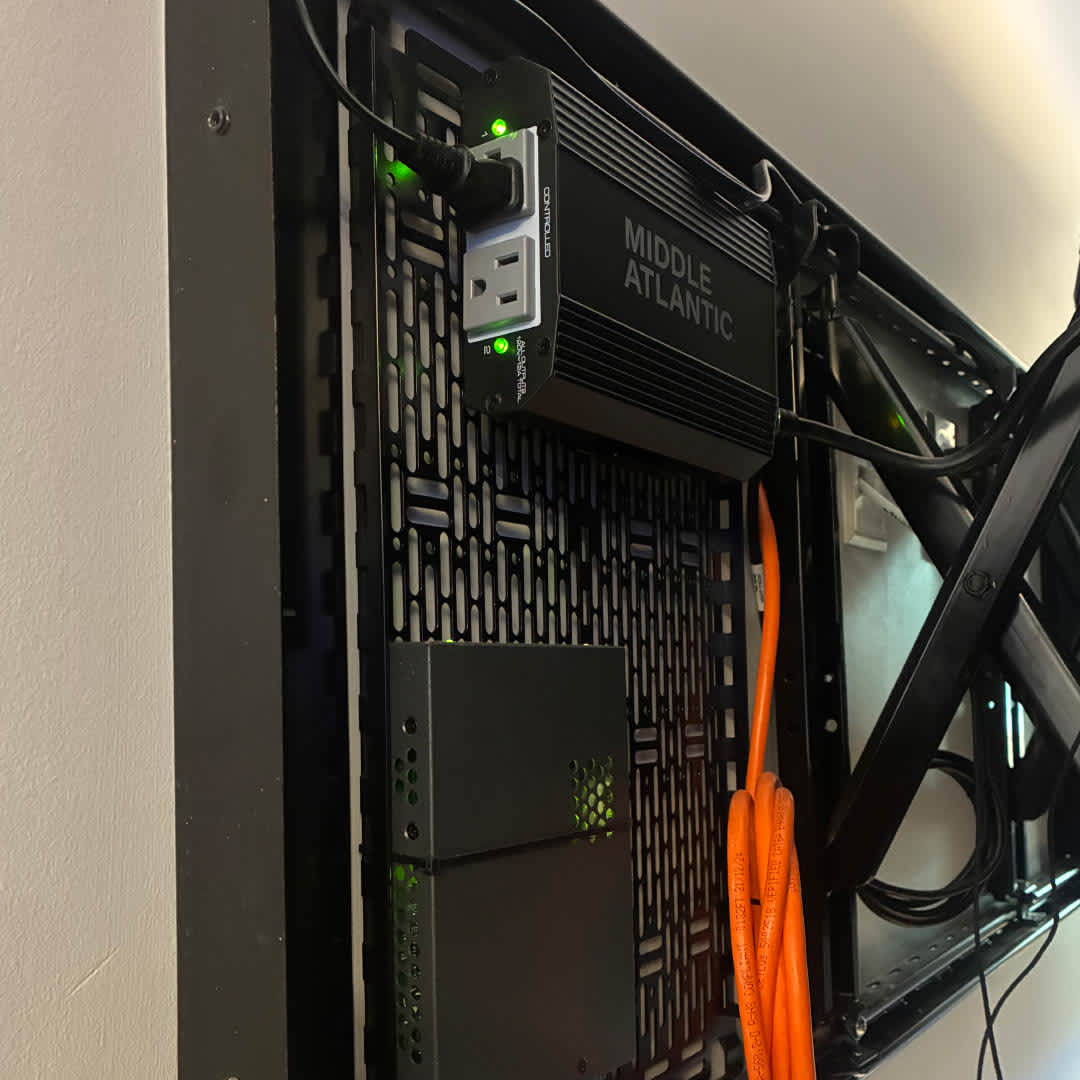
The deployment centered on three Middle Atlantic PDU models matched different space types: the RLNK-P920R-SP for instructor stations, the RLNK-215 for classroom displays, and the RLNK-415R for conference rooms. Each unit connects to the Legrand | AV Unified Cloud Platform, giving the team a single management interface for every outlet across the entire campus.
The setup sounds simple, but the details matter. Every outlet is named by device type, so when a support call comes in, there’s no guesswork about what’s plugged in where. Staff can search for any room directly from the device list or navigate through a building-and-room hierarchy. From there, they can see real-time amperage draw on each outlet — which tells them immediately whether a device has been locally powered off, unplugged, or is pulling unusual current that might signal a problem ahead. If a device needs a power cycle, they can target that specific outlet without affecting the rest of the room’s system, so the instructor can keep working while the fix happens in the background.
Aaron Dill, the team’s Audiovisual System Administrator for Classroom Technology, pushed the deployment further by building automation on top of the platform’s developer tools. Python scripts handle bulk configuration and firmware updates across the entire fleet, collapsing what would have been weeks of manual device-by-device work into a process that runs in the background. Autoping monitoring watches high-priority devices continuously and triggers an automatic power cycle the moment one stops communicating, resolving a class of issues before anyone needs to intervene. For situations that need hands-on access, SSH tunneling provides a secure path into the device web UI from off-campus, without requiring a VPN connection.
The Legrand | AV Unified Cloud Platform offline status indicator added another layer of intelligence: when a PDU itself goes offline, the team can distinguish immediately between a device-level issue and a broader building power or networking problem, changing how they triage and prioritize before they’ve even left their desks.
“Python scripts for bulk configuration and control have made mass deployment and updates very efficient,” said Aaron. “This has saved me weeks of work by not having to manually configure or update every device.”
What Remote Management Changed
The shift from reactive to proactive has been tangible. In just the first two weeks of the Spring 2026 semester, the team resolved 15 to 20 incidents entirely remotely, which meant that issues that previously would have required a trip across campus, a search through rack cabling, and time the instructor didn’t have to spare, were avoided. Classes that once faced cancellation because of a failed display or unresponsive control system are now resolved before the faculty member realizes anything went wrong.
The team has also gotten ahead of failures rather than just responding to them. Legrand | AV Unified Cloud Platform’s power monitoring surfaces devices drawing unusual current, an early warning sign that hardware may be approaching failure or that a power condition is putting equipment at risk. That visibility has changed how the MTSU team thinks about maintenance: instead of fixing things that have already broken, the team can now address problems that haven’t happened yet.
On the energy side, the ability to schedule automated power-downs for high-draw equipment — projectors, amplifiers, DSPs — during nights, weekends, and semester breaks has made a measurable difference. MTSU generates its own electricity on campus via natural gas, so every watt saved is a direct reduction in natural resource consumption. Copeland estimates the scheduling capability alone has cut idle power consumption by 15 percent or more across the estate. Reduced campus vehicle use from fewer site visits is a secondary benefit the team also tracks.
Copeland added: “We can remotely get a classroom back online faster than we ever could driving across campus.”
A Blueprint for Modern Campus AV
Legrand | AV Unified Cloud Platform is now a campus standard at MTSU. It’s currently deployed across 93 percent of instructional spaces, and Copeland is actively working toward 100 percent, which includes integration into new building designs from the start. The platform has moved from a pandemic-era workaround into a foundational piece of how the university operates.
What MTSU has built is less a technology deployment and more a reframing of what AV support can look like at scale. Three people managing 400-plus rooms isn’t a staffing problem to be solved with more headcount; it’s an operational model that only works if the technology does more of the work. Middle Atlantic’s Premium+ PDUs and Legrand | AV Unified Cloud Platform are the infrastructure that makes it possible.
“I feel like MTSU is redefining the standard for managing classroom technology at a university on a large scale, shifting from reactive break-fix cycles to a proactive approach via cloud management software,” concluded Copeland. “A key component of this strategy is MTSU’s partnership with Legrand | AV.”
AV Solutions for Higher Education
EasyIP Ecosystem Hub