


Why Thunderbolt™ is the Connectivity Solution for Today’s Demands and Tomorrow’s Innovation
When you’re designing and deploying high-performance AV systems, speed and simplicity are not optional. They are essential. The new Thunderbolt™ 5 USB-C® Cable delivers ultrafast 80 Gbps data transfer, support for up to three 4K displays at 144Hz, and 240W power delivery, all through a single Intel® certified cable.
Whether you are integrating solutions for corporate conference rooms, lecture halls, or highend broadcast environments, Thunderbolt 5 gives you the bandwidth, flexibility, and reliability to keep everything running seamlessly today and into the future.
Key Thunderbolt Advantages
Higher Bandwidth
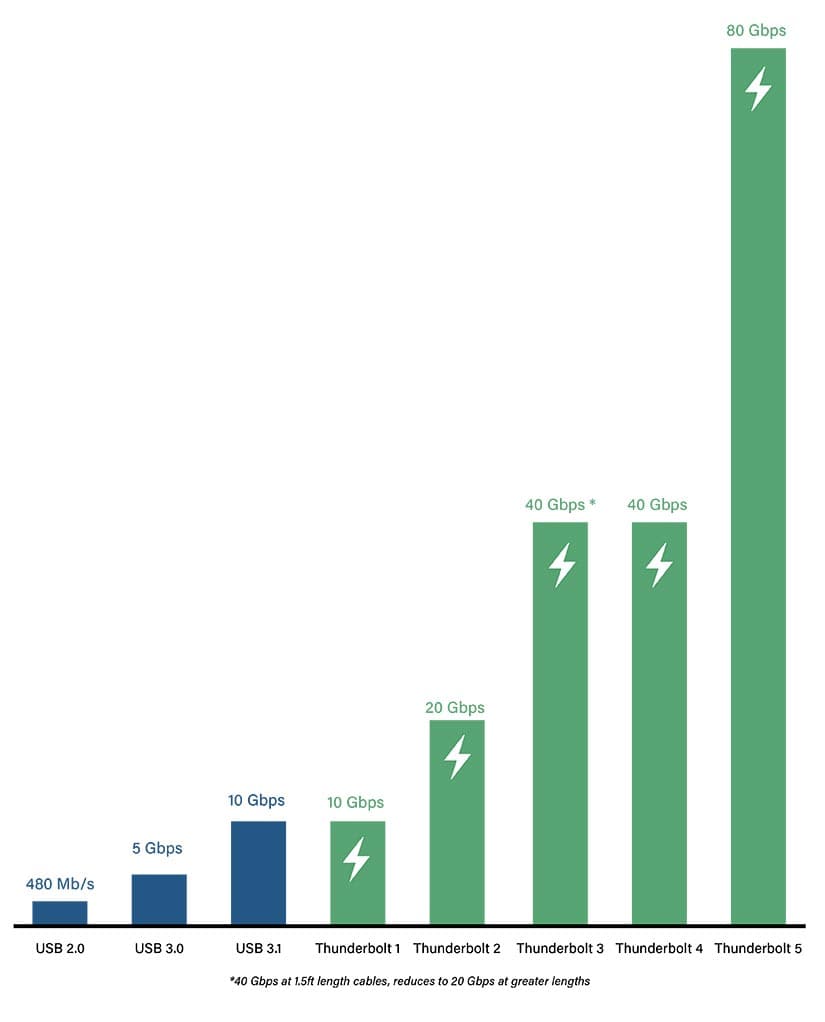
Thunderbolt 3 & 4 supports a maximum of 40 Gbps, while Thunderbolt 5 delivers up to 80 Gbps of bidirectional data transfer, which is twice the speed of USB4’s 40 Gbps, and it can boost bandwidth to 120 Gbps in one direction while maintaining 40 Gbps in the opposite.
Power Delivery
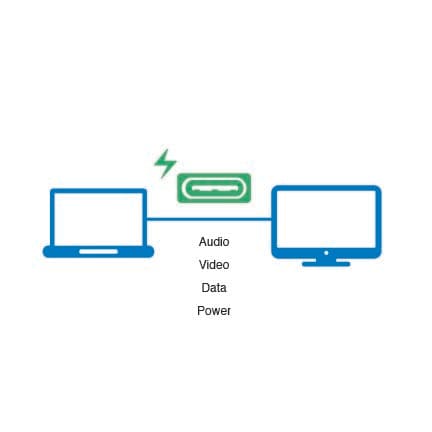
Supports USB Power Delivery typically up to 100W with Thunderbolt 4, and up to 240W with Thunderbolt 5.

Dual/Triple 4K or Single 8K Video Support
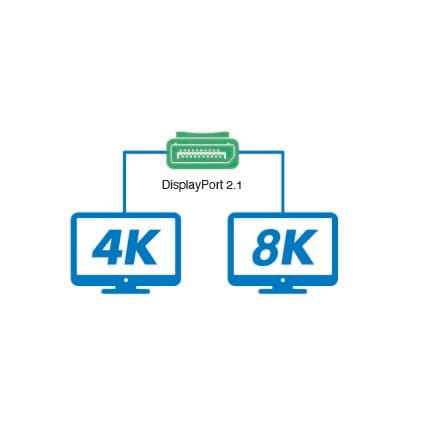
Thunderbolt cables feature integrated DisplayPort 2.1 Alt Mode, delivering crystal-clear visuals with support for a single display up to 8K or dual/Triple displays up to 4K. With low latency and ultra-fast data transfer, they’re ideal for live production, real-time audio, and high-resolution video.
Universal Capatibility
Found mostly on high-end laptops, desktops, and docking stations, Thunderbolt ports and cables offer advanced performance. Thunderbolt cables are backward-compatible with USB-C enabled devices; however, not all USB-C cables support Thunderbolt.
Daisy-Chain up to Five Devices
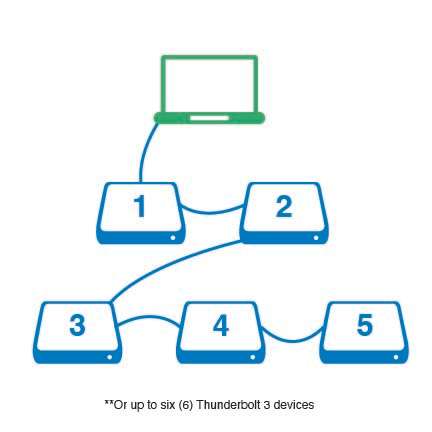
Thunderbolt was designed to eliminate cable clutter, by allowing the computer user to daisy-chain multiple devices such as monitors, printers, audio devices, and more. Thunderbolt 5 supports daisy chaining multiple devices natively while maintaining full speeds. USB4 does not natively support daisy chaining; each device generally needs its own port.
USB-C Limitations
Standard USB-C cables are not required to be certified, which means performance and capability can vary drastically. While some USB-C cables may offer decent speeds, others may be limited to USB 2.0 speeds (480 Mbps) a major problem in data-intensive workflows.
In short: just because a cable has a USB-C connector doesn’t mean it’s capable of supporting your system’s needs.

Thunderbolt Generations: What You Need to Know
Understanding the evolution of Thunderbolt helps clarify its advantages:
| USB4™ | Thunderbolt™ 4 | Thunderbolt™ 5 | |
| Max Bandwidth | 40 Gbps or 80 Gbps | 40 Gbps | 80 Gbps (up to 120 Gbps with Bandwidth Boost) |
| Single Display | Up to 8K @ 60Hz | Up to 8K @ 60Hz | Up to 8K @ 60Hz |
| Dual Display | Dual 4K @ 60Hz | Dual 4K @ 60Hz | Dual 8K @ 60Hz |
| Triple Display | Not officially supported | Not officially supported | Up to 3 x 4K @ 144Hz or 3 x 5K @ 60Hz |
| Power Delivery | Up to 100W | Up to 100W | Up to 240W |
| Certification | Optional (varies widely) | Mandatory | Mandatory |
| Compatibility | Fully backward compatible with Thunderbolt 3 and USB 3.2 devices | Fully compatible with USB4 and Thunderbolt 3 devices | Fully compatible with USB4, Thunderbolt 3, and Thunderbolt 4 devices |
While USB-C may seem similar on paper, not all USB-C devices and cables perform the same, whereas Thunderbolt, with its strict certification requirements, provides AV professionals with a consistent and reliable solution.
Why Choose Thunderbolt
For AV professionals, choosing the right cable is about more than just signal transmission, it’s about ensuring reliability, minimizing latency, and reducing the risk of incompatibility.
Key Benefits in AV Installs
- Guaranteed Performance: Certified Thunderbolt cables reduce signal loss and interference, even in complex environments.
- Simplified Infrastructure: One Thunderbolt cable can replace multiple signal paths for data, power, and video, which helps reduce clutter and cost.
- Interoperability: Thunderbolt’s cross compatibility with PCIe and DisplayPort simplifies system design and future upgrades.
- Professional Grade Reliability: In critical installs, from control rooms to broadcast environments, Thunderbolt delivers predictable results.
Real-World Applications Across Industries
Federal / Government Use Case
Secure Command & Control Centers
Thunderbolt supports high-bandwidth, AV-over-IP systems essential in military and emergency ops. Rapid transfer of encrypted video feeds and real-time data ensures accurate, synchronized decision-making.

Residential Use Case
High-Fidelity Home Recording Studios
Thunderbolt audio interfaces (like the Apollo Twin) offer ultra-low latency and real-time DSP processing for professional-grade home studios.

Commercial Offices Use Case
Multi-Monitor Thunderbolt Docking
Thunderbolt docks simplify connectivity, enabling dual/triple 4K displays, Ethernet, and USB peripherals, all over a single cable, ideal for hybrid work setups.

Retail Use Case
Digital Signage & Interactive Kiosks
Drive high-resolution signage, real-time updates, and interactive experiences with Thunderbolt’s robust bandwidth and display support.

The Thunderbolt Ecosystem: Products That Leverage Its Power
Thunderbolt isn't just for cables, it's the backbone of a growing product ecosystem, including:
- Docking Stations
- Professional Laptops (e.g., Apple MacBook Pro)
- High-Speed SSDs
- Pro-Grade Monitors
- External GPUs and AI Accelerators
With many devices only offering Thunderbolt ports (especially in the Apple ecosystem), using uncertified USB-C cables risks underperformance or device failure.
Thunderbolt 4 & 5: Powering the Next Generation of AV
Thunderbolt 4 made high-performance AV setups more reliable and user-friendly. Thunderbolt 5 takes that leap even further enabling next-gen applications like:
- External AI acceleration hardware
- 120 Gbps video feeds
- Support dual displays at 4K resolution
- Minimal latency for seamless gaming and streaming experiences
- 240W power delivery for power-demanding systems
As the AV industry evolves toward higher resolution, faster refresh rates, and greater computing demands, Thunderbolt is already equipped for the future.
Final Thoughts: Is Thunderbolt Worth It?
While Thunderbolt cables and devices are typically more expensive than standard USB-C, the performance, reliability, and peace of mind they offer are unmatched. In AV environments where data integrity, visual clarity, and uptime matter, Thunderbolt ensures professionals can meet the highest standards with confidence.
With Thunderbolt, you’re not just choosing a cable, you’re choosing a future-proof, professional-grade solution.
Need Help Choosing the Right Thunderbolt Solution?
Whether you’re specifying AV for a government facility, outfitting a commercial office, or designing a high-end home studio, our team can help you integrate Thunderbolt for optimal performance and reliability. Contact us for product recommendations and installation guidance.